Car Hauler Trailer Manufacturer
Legacy context
Preserved shop record for deandetrailers.com. The former plant is not quoting from this domain.
D & D Trailers, Inc. — preserved page language, car hauler trailer manufacturer
The preserved pages of deandetrailers.com carry a shop record rather than a sales pitch. The company identifies itself as D & D Trailers, Inc., a New Jersey corporation formed in 1976 from a proprietorship begun in 1970. The stated objective was, and is, the manufacture and distribution of trailers. The preserved About page adds that the shop designed and manufactured trailers for the very largest corporations to carry many diverse items, including automobiles. The motto preserved there is “Custom Trailers Our Specialty,” and the page explains that phrase in shop terms: begin with a proven design and add any modification the customer may desire. That is the frame for everything below. The car hauler trailer is not treated as a separate catalog item with a fixed specification sheet. It is treated as a build within the Auto Carrier series, using the same process language as the landscape, equipment, and utility series. The preserved build index lists the series in a fixed order: Build Your Own Auto Carrier, Build Your Own Landscape Series, Build Your Own Equipment Series, Build Your Own Utility Series. Each series page repeats the same header and the same “See the DEANDE Difference” line. The Auto Carrier page is the one that governs the car hauler. Its build fields begin with Gross Vehicle Weight, or G.V.W. The preserved options are 2990 LB with one 3500 LB axle; 7500 LB with two 3500 LB axles and four-wheel electric brakes; and 10,000 LB with two 6000 LB axles and a 2x6x3/16 inch tube frame. Those are the recorded weight classes. The page does not present them as trim levels. They are the first decision in the build, and the frame and axle language follows from that decision. Overall width is the next recorded field. The preserved choices are 96 inches overall width with 78 inches between fenders, and 102 inches overall width with 82 inches between fenders. The page also states that special widths are available. That line matters because it keeps the build inside the shop’s process rather than inside a fixed catalog. A car hauler built on this pattern is not limited to the two recorded widths if the customer’s modification calls for something else. Length of main bed is the third recorded field. The preserved Auto Carrier page lists 16 foot bed with two each 19 inch wide runners, 18 foot bed with two each 19 inch wide runners, 20 foot bed with two each 19 inch wide runners, and 22 foot bed. The page notes that five feet should be added to all trailers below for overall length. The runner language is specific to the Auto Carrier series. The landscape and equipment pages do not use it. On those pages the bed lengths run 16, 18, 20, 22, and 24 feet, with other lengths available and specified in the comments section. The Auto Carrier page carries the same “other lengths available” instruction in its preserved form, so the recorded bed lengths are starting points, not limits. The equipment series page shows how the shop records a build when the trailer is not a car hauler. Its G.V.W. options are 6000 LB with two axles, 16 foot bed, and four-wheel electric brakes; 7500 LB with two axles, 16 foot bed, and four-wheel electric brakes; and 10,000 LB with two axles, 16 foot bed, and four-wheel electric brakes. The landscape series page adds a lighter class: 2990 LB with one axle and a 12 foot bed, and 2990 LB with one axle and a 14 foot bed. The same width fields appear across the series: 96 inches overall with 78 inches between fenders, 102 inches overall with 82 inches between fenders, and special widths available. The same bed length fields appear, with the same five-foot note for overall length. The equipment page also carries a Deck Over Deck line. The Auto Carrier page does not. That difference is part of the preserved record and should be kept as a difference. The About page supplies the process language that ties the series together. It says the shop specializes in customer service beginning with answering all questions before the purchase and continuing to supply parts and service many years after the sale. It says many loyal customers contact the company years later when it is time to order additional trailers and suggest special changes, only to find those items standard on the latest models. It says the series of trailers are being continuously tested and upgraded. Those statements are not marketing claims about a single car hauler. They describe how a build moves through the shop: a proven design is the baseline, modifications are added, and the resulting changes can later become standard. The preserved build pages also show the intake fields used to start a build. First name, last name, street address, city, state, zip code, telephone, fax, and email are recorded, with required fields marked. The build pages do not quote from this domain now. They are preserved as a record of how the shop organized a car hauler build: G.V.W. first, then overall width, then length of main bed, with runner widths recorded for the Auto Carrier series and special widths and other lengths available by specification in the comments section. The location page records shop hours as Monday through Friday 8:00 am till 4:00 pm and Saturday 8:00 am till 12:00 noon, with holiday and car show weekends to be confirmed. Directions are given by route and exit, not by street address. That is consistent with the rest of the preserved record: the shop speaks in build fields, series names, and process steps, and the car hauler trailer manufacturer identity is carried by the Auto Carrier series and its recorded options.
Surface finish reference
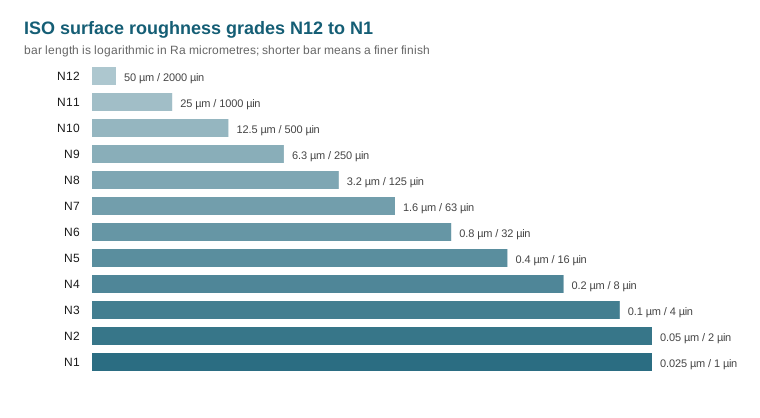
| ISO grade | Ra (µm) | Ra (µin) | RMS (µin) | CLA (µin) | Rt (µm) |
|---|---|---|---|---|---|
| N12 | 50 | 2000 | 2200 | 2000 | 200 |
| N11 | 25 | 1000 | 1100 | 1000 | 100 |
| N10 | 12.5 | 500 | 550 | 500 | 50 |
| N9 | 6.3 | 250 | 275 | 250 | 25 |
| N8 | 3.2 | 125 | 137.5 | 125 | 13 |
| N7 | 1.6 | 63 | 69.3 | 63 | 8 |
| N6 | 0.8 | 32 | 35.2 | 32 | 4 |
| N5 | 0.4 | 16 | 17.6 | 16 | 2 |
| N4 | 0.2 | 8 | 8.8 | 8 | 1.2 |
| N3 | 0.1 | 4 | 4.4 | 4 | 0.8 |
| N2 | 0.05 | 2 | 2.2 | 2 | 0.5 |
| N1 | 0.025 | 1 | 1.1 | 1 | 0.3 |
Common questions
What does N8 surface finish mean?
N8 is Ra 3.2 micrometres, or 125 microinches. The equivalent RMS reading is 137.5 microinch and the CLA figure is 125 microinch. Grades run from N12 (roughest, Ra 50) down to N1 (finest, Ra 0.025).
What does N7 surface finish mean?
N7 is Ra 1.6 micrometres, or 63 microinches. The equivalent RMS reading is 69.3 microinch and the CLA figure is 63 microinch. Grades run from N12 (roughest, Ra 50) down to N1 (finest, Ra 0.025).
What does N5 surface finish mean?
N5 is Ra 0.4 micrometres, or 16 microinches. The equivalent RMS reading is 17.6 microinch and the CLA figure is 16 microinch. Grades run from N12 (roughest, Ra 50) down to N1 (finest, Ra 0.025).
This page is an archival note for informational purposes only. It does not offer representation, evaluate claims, or create a professional relationship.