Enclosed Cargo Trailer Manufacturer
Overview
Preserved Shop Record: deandetrailers.com Subject: Enclosed Cargo Trailer Manufacturing Process Language The preserved pages of deandetrailers.com carry a shop record for D & D Trailers, Inc., a New Jersey corporation formed in 1976 from a proprietorship begun in 1970. The stated objective of the company was, and is, the manufacture and distribution of trailers. The preserved build pages show a configurator organized around series: auto carrier, landscape series, equipment series, and utility series. The preserved about page states the motto "Custom Trailers Our Specialty," and describes a process that begins with a proven design and adds any modification the customer may desire. The preserved location page lists shop hours and directions, but the former plant is not quoting from this domain. What follows is a shop-floor reading of the enclosed cargo trailer manufacturing process, kept
Details
inside the language of the preserved record. The preserved build pages do not present an enclosed cargo series by name. They present the same structural decision points that an enclosed cargo build would inherit: gross vehicle weight, overall width, length of main bed, and axle count. In the equipment series, the preserved options run 6000 LB GVW with two axles, 16-foot bed, and four-wheel electric brakes; 7500 LB GVW with two axles, 16-foot bed, and four-wheel electric brakes; and 10,000 LB GVW with two axles, 16-foot bed, and four-wheel electric brakes. Overall width is listed as 96 inches overall with 78 inches between fenders, or 102 inches overall with 82 inches between fenders, with special widths available. Length of main bed is listed as 16, 18, 20, 22, or 24 feet, with the note to add 5 feet to all trailers above for overall length, and other lengths available by specification in the comments section. Deck over deck is named as an option. The landscape series repeats the same width and length language and adds a 2990 LB GVW single-axle choice at 12-foot and 14-foot beds. The auto carrier page lists 2990 LB with one 3500 LB axle; 7500 LB with two 3500 LB axles and four-wheel electric brakes; and 10,000 LB with two 6000 LB axles and a 2x6x3/16 inch tube frame. It also names 19-inch wide runners in pairs at 16, 18, 20, and 22 feet. For an enclosed cargo trailer, the shop process begins with those same framing decisions. The gross vehicle weight sets the axle schedule and the brake schedule. A single-axle build at 2990 LB carries one axle and no four-wheel electric brake package in the preserved language. A two-axle build at 6000 LB, 7500 LB, or 10,000 LB carries the four-wheel electric brake package where the preserved pages name it. The 10,000 LB auto carrier line names a 2x6x3/16 inch tube frame, which is the heaviest frame section called out in the preserved record. The enclosed cargo build would take its frame cue from the same schedule: the higher the gross vehicle weight, the heavier the main frame tube and the more crossmembers the bed section requires. Overall width is the next process gate. The preserved pages offer 96 inches overall with 78 inches between fenders, or 102 inches overall with 82 inches between fenders. On an enclosed cargo trailer, the between-fenders dimension governs the clear floor width inside the wheel boxes. The overall width governs the exterior wall plane and the roof width. Special widths are available, which means the shop will cut and fit wall studs and roof bows to a non-standard overall width when the build sheet calls for it. The preserved language does not name a wall height, a roof radius, or a side door size, so those remain open specification items in the comments section, consistent with the custom-specialty motto. Length of main bed is the third gate. The preserved pages list 16, 18, 20, 22, and 24 feet, with the note to add 5 feet to all trailers above for overall length. On an enclosed cargo trailer, the main bed length becomes the interior box length before the tongue and rear frame are added. The 5-foot addition covers the tongue, the coupler, and the rear overhang in the overall length figure. Other lengths are available by specification in the comments section, which is where a non-standard enclosed box length would be written. The preserved about page describes the shop method: begin with a proven design and add any modification you may desire. The series pages are being continuously tested and upgraded. Many loyal customers contact the shop years later when it is time to order additional trailers and suggest special changes, only to find these items standard on the latest models. That is the process language of a build-to-order shop. An enclosed cargo trailer from this plant would start from the proven frame and axle schedule shown on the preserved pages, take its width and length from the configurator gates, and carry any further modification as a written specification in the comments section. The former plant is not quoting from this domain. This record preserves the shop's own process language for the enclosed cargo trailer manufacturer topic.
Thread and tap drill reference
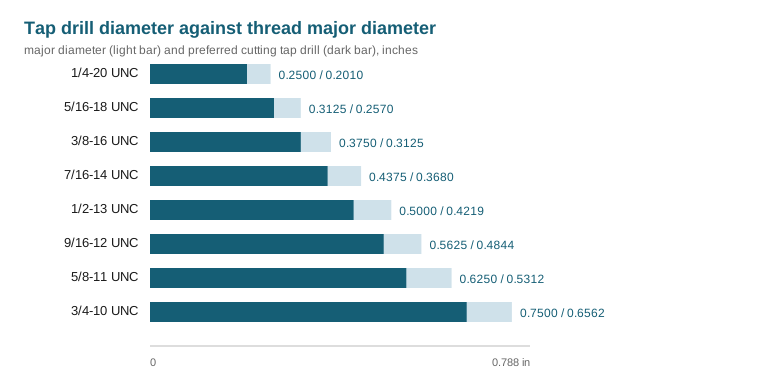
| Thread | Major dia (in) | Major dia (mm) | TPI | Tap drill | Drill dia (in) | Drill dia (mm) |
|---|---|---|---|---|---|---|
| 1/4-20 UNC | 0.2500 | 6.350 | 20 | #7 | 0.2010 | 5.105 |
| 5/16-18 UNC | 0.3125 | 7.938 | 18 | F | 0.2570 | 6.528 |
| 3/8-16 UNC | 0.3750 | 9.525 | 16 | 5/16 | 0.3125 | 7.938 |
| 7/16-14 UNC | 0.4375 | 11.113 | 14 | U | 0.3680 | 9.347 |
| 1/2-13 UNC | 0.5000 | 12.700 | 13 | 27/64 | 0.4219 | 10.716 |
| 9/16-12 UNC | 0.5625 | 14.287 | 12 | 31/64 | 0.4844 | 12.303 |
| 5/8-11 UNC | 0.6250 | 15.875 | 11 | 17/32 | 0.5312 | 13.494 |
| 3/4-10 UNC | 0.7500 | 19.050 | 10 | 21/32 | 0.6562 | 16.669 |
| #10-24 UNC | 0.1900 | 4.826 | 24 | #25 | 0.1495 | 3.797 |
| #8-32 UNC | 0.1640 | 4.166 | 32 | #29 | 0.1360 | 3.454 |
| #6-32 UNC | 0.1380 | 3.505 | 32 | #36 | 0.1065 | 2.705 |
| #4-40 UNC | 0.1120 | 2.845 | 40 | #43 | 0.0890 | 2.261 |
Common questions
What size drill do you use for a 1/4-20 UNC tap?
A #7 drill, 0.2010 in (5.105 mm). That is the preferred cutting tap drill for 1/4-20 UNC, which has a major diameter of 0.2500 in (6.350 mm) and 20 threads per inch.
What size drill do you use for a 5/16-18 UNC tap?
A F drill, 0.2570 in (6.528 mm). That is the preferred cutting tap drill for 5/16-18 UNC, which has a major diameter of 0.3125 in (7.938 mm) and 18 threads per inch.
What size drill do you use for a 3/8-16 UNC tap?
A 5/16 drill, 0.3125 in (7.938 mm). That is the preferred cutting tap drill for 3/8-16 UNC, which has a major diameter of 0.3750 in (9.525 mm) and 16 threads per inch.
This page is an archival note for informational purposes only. It does not offer representation, evaluate claims, or create a professional relationship.