Custom Trailer Manufacturer
Overview
Preserved shop record for deandetrailers.com. The former plant is not quoting from this domain. The preserved pages of D & D Trailers, Inc. read like a build sheet that never left the shop floor. The company described itself as a New Jersey corporation formed in 1976 from a proprietorship begun in 1970. Its stated objective was the manufacture and distribution of trailers. The motto carried on the about page was "Custom Trailers Our Specialty," and the surrounding language explains what that meant in practice: begin with a proven design and add any modification the customer desired. That single sentence is the spine of the whole record. Everything else on the preserved pages is the working-out of it. The build pages are organized by series. There is a Build Your Own Auto Carrier, a Build Your Own Landscape Series, a Build Your Own Equipment Series, and a Build Your Own Utility Series.
Details
Each series page opens the same way, with a short line pointing to the DEANDE difference, then a set of required contact fields, then the actual specification choices. The contact block asks for first name, last name, street address, city, state, zip code, telephone, fax, and email. The asterisk marks required information. That block is not a price sheet and not a request-for-quote form in the modern sense; it is the front end of a build conversation, the point at which a customer's name and location get attached to a set of dimensions. The Equipment Series page shows the pattern most clearly. Gross vehicle weight is offered in three steps: 6000 LB GVW with two axles, a 16-foot bed, and four-wheel electric brakes; 7500 LB GVW with two axles, a 16-foot bed, and four-wheel electric brakes; and 10,000 LB GVW with two axles, a 16-foot bed, and four-wheel electric brakes. Overall width is offered at 96 inches overall with 78 inches between fenders, or 102 inches overall with 82 inches between fenders. Special widths are available. Length of main bed is offered at 16, 18, 20, 22, and 24 feet, with the note that five feet should be added to all trailers above for overall length. Other lengths are available, to be specified in the comments section. Deck over deck is listed as a further option. The Landscape Series page repeats the same width and length choices but changes the weight ladder at the bottom. It begins with 2990 LB GVW, one axle, 12-foot bed, and 2990 LB GVW, one axle, 14-foot bed. Then it steps up to 6000 LB GVW with two axles, 16-foot bed, four-wheel electric brakes; 7500 LB GVW with two axles, 16-foot bed, four-wheel electric brakes; and 10,000 LB GVW with two axles, 16-foot bed, four-wheel electric brakes. The width choices and the bed-length choices carry over unchanged, including the five-foot addition for overall length and the invitation to specify other lengths in the comments section. The Auto Carrier page uses a different weight ladder. It lists 2990 LB with one 3500 LB axle; 7500 LB with two 3500 LB axles and four-wheel electric brakes; and 10,000 LB with two 6000 LB axles and a 2x6x3/16 inch tube frame. Width again runs 96 inches overall with 78 inches between fenders, or 102 inches overall with 82 inches between fenders, with special widths available. Length of main bed is given as 16-foot bed with two each 19-inch wide runners, 18-foot bed with two each 19-inch wide runners, 20-foot bed with two each 19-inch wide runners, and 22-foot bed. The runner language is specific to the auto carrier, because the vehicle rides on those runners rather than on a flat deck. What holds these pages together is the shop's process vocabulary. Gross vehicle weight, axles, bed length, overall width, width between fenders, electric brakes, tube frame, runners, deck over deck, special widths, other lengths. These are not marketing abstractions. They are the variables a builder sets before steel is cut. The preserved pages do not quote a price and do not promise a delivery date. They ask the customer to choose from a proven design and then to write the exceptions in the comments section. That is the modification path the about page describes. The about page also states that the company designed and manufactured trailers for the very largest corporations to carry many diverse items, including automobiles. It says the series of trailers are continuously tested and upgraded. It notes that loyal customers contact the company years later to order additional trailers and suggest special changes, only to find those items standard on the latest models. That is a closed loop between custom work and standard catalog: a modification requested once becomes a production feature later. The build pages are the intake side of that loop. The location page adds the working rhythm. Hours were Monday through Friday 8:00 am till 4:00 pm, Saturday 8:00 am till 12:00 noon, with holiday and car show weekends requiring a call to confirm. Directions are given from the east, north, west or Philadelphia area, and south Jersey, using interstate and route landmarks and turns. The plant sat in an industrial park at the end of a street. None of that changes the build language, but it places the build language in a real shop with real hours and a real floor. For anyone reading this preserved record as a custom trailer manufacturer's process document, the lesson is in the sequence. Pick a series. Pick a gross vehicle weight. Pick an axle count and brake arrangement. Pick an overall width and the width between fenders. Pick a main bed length, remembering the five-foot addition for overall length. Note any special width or other length in the comments. Then the proven design gets modified to suit. The former plant is not quoting from this domain, but the preserved pages still show how it framed a custom build: start from what is known, then write down what is different.
Drill size reference
| Drill | Decimal inch | Millimetres |
|---|---|---|
| #1 | 0.2280 | 5.791 |
| #7 | 0.2010 | 5.105 |
| #13 | 0.1850 | 4.699 |
| #21 | 0.1590 | 4.039 |
| #29 | 0.1360 | 3.454 |
| #36 | 0.1065 | 2.705 |
| #43 | 0.0890 | 2.261 |
| #53 | 0.0595 | 1.511 |
| 1/16 | 0.0625 | 1.587 |
| 5/64 | 0.0781 | 1.984 |
| 3/32 | 0.0938 | 2.381 |
| 7/64 | 0.1094 | 2.778 |
| 1/8 | 0.1250 | 3.175 |
| 9/64 | 0.1406 | 3.572 |
| 5/32 | 0.1562 | 3.969 |
| 11/64 | 0.1719 | 4.366 |
| 3/16 | 0.1875 | 4.763 |
| 13/64 | 0.2031 | 5.159 |
| 7/32 | 0.2188 | 5.556 |
| 15/64 | 0.2344 | 5.953 |
| 1/4 | 0.2500 | 6.350 |
| 5/16 | 0.3125 | 7.938 |
| 3/8 | 0.3750 | 9.525 |
| 7/16 | 0.4375 | 11.113 |
| 1/2 | 0.5000 | 12.700 |
| F | 0.2570 | 6.528 |
| H | 0.2660 | 6.756 |
| L | 0.2900 | 7.366 |
| P | 0.3230 | 8.204 |
| S | 0.3480 | 8.839 |
| W | 0.3860 | 9.804 |
| Z | 0.4130 | 10.490 |
Common questions
What is a #1 drill bit in inches and millimetres?
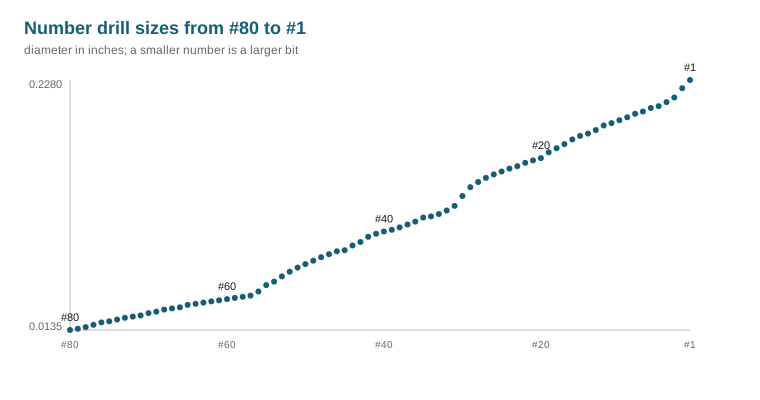
A #1 drill bit is 0.2280 in, which is 5.791 mm. Number drills run from #80 at 0.0135 in up to #1 at 0.2280 in, so a smaller number is always a larger bit.
What is a #7 drill bit in inches and millimetres?
A #7 drill bit is 0.2010 in, which is 5.105 mm. Number drills run from #80 at 0.0135 in up to #1 at 0.2280 in, so a smaller number is always a larger bit.
What is a #13 drill bit in inches and millimetres?
A #13 drill bit is 0.1850 in, which is 4.699 mm. Number drills run from #80 at 0.0135 in up to #1 at 0.2280 in, so a smaller number is always a larger bit.
This page is an archival note for informational purposes only. It does not offer representation, evaluate claims, or create a professional relationship.