Short-Run Metal Work
Overview
Preserved shop record for deandetrailers.com. The former plant is not quoting from this domain. The preserved pages describe a trailer manufacturing operation that began as a proprietorship in 1970 and was formed as a New Jersey corporation in 1976. The stated objective was manufacture and distribution of trailers. The shop built for large corporations and for diverse hauling needs, including automobiles. Its motto, Custom Trailers Our Specialty, is not a slogan so much as a description of how work moved through the plant: begin with a proven design, then add any modification the customer desired. The build pages show that logic in detail. Auto carrier, landscape series, equipment series, and utility series each had a configurator-style page where gross vehicle weight, overall width, bed length, and deck-over options were selected. Equipment series listed 6000 LB GVW with two axles, 16-
Details
foot bed, and four-wheel electric brakes; 7500 LB GVW with two axles, 16-foot bed, and four-wheel electric brakes; and 10,000 LB GVW with two axles, 16-foot bed, and four-wheel electric brakes. Overall width choices were 96 inches with 78 inches between fenders, or 102 inches with 82 inches between fenders, with special widths available. Main bed lengths ran 16, 18, 20, 22, and 24 feet, with other lengths available by specification. The landscape series added 2990 LB GVW single-axle beds at 12 and 14 feet. The auto carrier page listed 2990 LB with one 3500 LB axle, 7500 LB with two 3500 LB axles and four-wheel electric brakes, and 10,000 LB with two 6000 LB axles and a 2x6x3/16 inch tube frame. Auto carrier beds used two 19-inch wide runners. Across all series, the overall length note was consistent: add 5 feet to the main bed for overall length. That preserved language is the process language of short run metal fabrication. The shop did not publish a catalog of fixed stock numbers. It published a set of base frames and a list of variables. A customer chose a gross vehicle weight, which set the axle count and brake arrangement. A customer chose an overall width, which set the fender spacing and the crossmember span. A customer chose a main bed length, which set the frame rail cut length and the number of crossmembers. Then the shop added or removed features. Deck over was one option. Special widths were another. Other lengths were another. The about page says the company would begin with a proven design and add any modification desired. That is the short run model: a known platform, a bounded set of changes, and a build sequence that can absorb those changes without starting from a blank sheet. In a shop like that, short run metal fabrication is not a separate department. It is the normal way work arrives. The base design is already proven. The variables are already understood. The fabrication steps are already sequenced. What changes is the cut list, the drill pattern, the weld fixture setup, and the finish schedule. A 16-foot equipment trailer and a 24-foot equipment trailer share the same series logic, but they do not share the same rail stock. A 96-inch overall width and a 102-inch overall width share the same fender concept, but they do not share the same crossmember length. A 2990 LB single-axle landscape trailer and a 10,000 LB two-axle landscape trailer share the same bed language, but they do not share the same axle mounting plates or brake wiring. The shop's build pages are essentially a short run fabrication order form. They ask for the variables that determine the metal. The preserved location page gives the operating rhythm. Hours were Monday through Friday 8:00 am till 4:00 pm, Saturday 8:00 am till 12:00 noon, with holiday and car show weekends requiring a call to confirm. Directions came from Interstate 195, Route 29, the New Jersey Turnpike, Interstate 95, Scotch Road, Route 295, and local industrial park streets. The shop sat at the end of a street in an industrial park. That is a practical detail for short run metal fabrication. Material deliveries, cut stock, and finished frames need a yard and a dock that can handle varied lengths and widths. A plant that builds 16-foot beds and 24-foot beds, 96-inch overall widths and 102-inch overall widths, and special widths on request needs space to stage long stock and to move partially assembled frames. The location page confirms that kind of space existed. The about page also describes a service arc that matters to short run work. The company answered questions before purchase, supplied parts and service years after sale, and saw loyal customers return to order additional trailers with special changes. Those changes sometimes became standard on later models. That is a feedback loop between fabrication and design. A modification that works on one short run can be folded into the proven design for the next run. The shop's series pages show the result: a set of base models with a wide but bounded list of options. The options are not random. They are the accumulated modifications that proved useful enough to keep. For anyone reading the preserved record as a shop record, the lesson is that short run metal fabrication depends on a stable platform and a clear variable list. The platform here is the trailer series: auto carrier, landscape, equipment, utility. The variable list is gross vehicle weight, overall width, main bed length, deck over, special widths, and other lengths. The process language is axle count, brake arrangement, tube frame, fender spacing, bed runners, and overall length. The shop did not need to quote from this domain to demonstrate that model. The preserved pages already show it. They show a plant that began with a proven design, added any modification desired, and kept the fabrication sequence close enough to the customer that changes could be absorbed without losing the base. That is short run metal fabrication in its plainest form: known frame, known steps, variable cut list, and a build that stays inside the shop's process language.
Drill size reference
| Drill | Decimal inch | Millimetres |
|---|---|---|
| #1 | 0.2280 | 5.791 |
| #7 | 0.2010 | 5.105 |
| #13 | 0.1850 | 4.699 |
| #21 | 0.1590 | 4.039 |
| #29 | 0.1360 | 3.454 |
| #36 | 0.1065 | 2.705 |
| #43 | 0.0890 | 2.261 |
| #53 | 0.0595 | 1.511 |
| 1/16 | 0.0625 | 1.587 |
| 5/64 | 0.0781 | 1.984 |
| 3/32 | 0.0938 | 2.381 |
| 7/64 | 0.1094 | 2.778 |
| 1/8 | 0.1250 | 3.175 |
| 9/64 | 0.1406 | 3.572 |
| 5/32 | 0.1562 | 3.969 |
| 11/64 | 0.1719 | 4.366 |
| 3/16 | 0.1875 | 4.763 |
| 13/64 | 0.2031 | 5.159 |
| 7/32 | 0.2188 | 5.556 |
| 15/64 | 0.2344 | 5.953 |
| 1/4 | 0.2500 | 6.350 |
| 5/16 | 0.3125 | 7.938 |
| 3/8 | 0.3750 | 9.525 |
| 7/16 | 0.4375 | 11.113 |
| 1/2 | 0.5000 | 12.700 |
| F | 0.2570 | 6.528 |
| H | 0.2660 | 6.756 |
| L | 0.2900 | 7.366 |
| P | 0.3230 | 8.204 |
| S | 0.3480 | 8.839 |
| W | 0.3860 | 9.804 |
| Z | 0.4130 | 10.490 |
Common questions
What is a #1 drill bit in inches and millimetres?
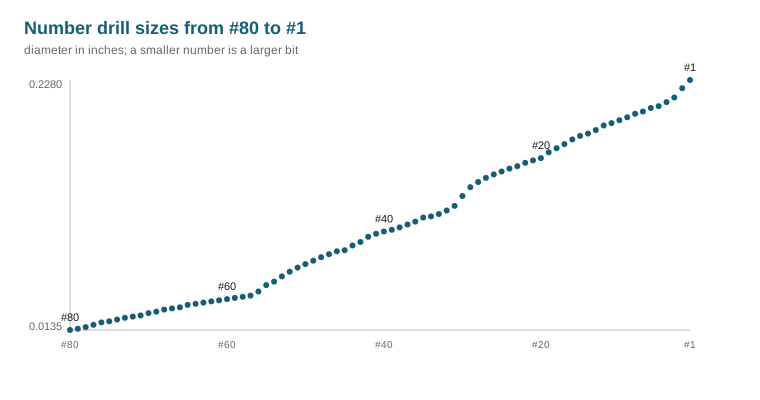
A #1 drill bit is 0.2280 in, which is 5.791 mm. Number drills run from #80 at 0.0135 in up to #1 at 0.2280 in, so a smaller number is always a larger bit.
What is a #7 drill bit in inches and millimetres?
A #7 drill bit is 0.2010 in, which is 5.105 mm. Number drills run from #80 at 0.0135 in up to #1 at 0.2280 in, so a smaller number is always a larger bit.
What is a #13 drill bit in inches and millimetres?
A #13 drill bit is 0.1850 in, which is 4.699 mm. Number drills run from #80 at 0.0135 in up to #1 at 0.2280 in, so a smaller number is always a larger bit.
This page is an archival note for informational purposes only. It does not offer representation, evaluate claims, or create a professional relationship.